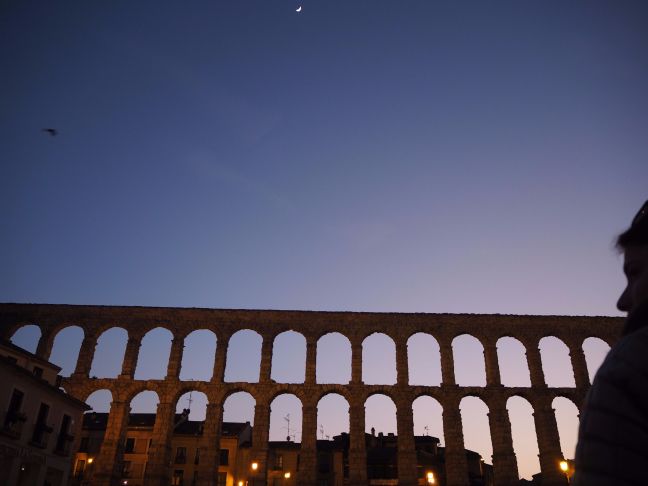
One of the benefits of arriving early somewhere is that it is empty. The downside is getting up at 6 AM on vacation to do that. Nevertheless, Segovia is a place well worth the effort. Home to one of the longest remaining and intact Roman aqueducts in the world, it is the most amazing thing we have ever seen. Nothing more to add except for a few pictures maybe.


After a while of standing in awe and walking the length of the aqueduct and a little breakfast at Dunkin Coffee (not Dunkin Donuts), we headed to the Cathedral of Segovia for Mass. On the way to Mass we heard what sounded like a parade starting up, but instead of the music of a whole band, we heard one single drumbeat. What we stumbled upon was a rehearsal for Semana Santa.
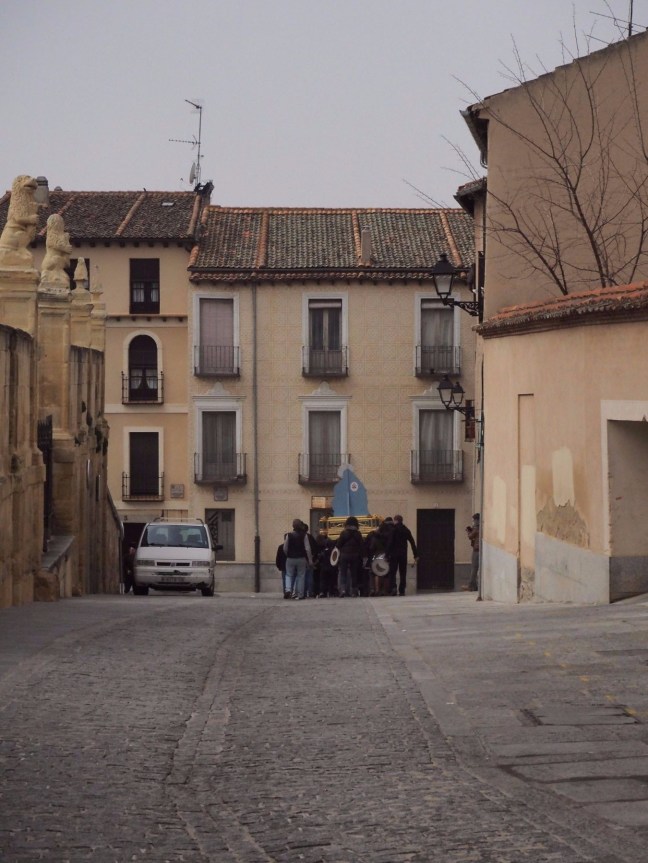
If you are not familiar with the holy week preparations in Spain, it involves a huge “parade” of sorts where statues weighing hundreds of pounds are carried on the backs of volunteers. Each towns celebrations are a little different. What we happended to witness in Segovia was the volunteers practicing. On their back was a cardboard cutout of the statue. We assume they were practicing keeping in time so that when it is the real deal, they don’t drop and destroy the hundred year old statue.
After looking in awe at the rehearsal we headed into the cathedral for Mass. We weren’t sure where to go exactly, but we followed a man that was walking with purpose and he led us to the chapel we needed. Again I (Elizabeth) was not struck by the Holy Spirit with the ability to understand Spanish, but the priest spoke beautifully during the homily.
During Mass, the altar began to beat like it had a heart, dull but consistent, ever present. Then the tinkling of chimes appeared to follow in tune with the heart beat. Turns out the xylophone sounds were just a rouge unsilenced cell phone. And we figure the heart beat was the drums from the practice parade and not from anyone buried behind the altar, like the Tell-Tale Heart. But it was exciting for a few minutes.


After Mass we got a map of Segovia and some information from the local tourist office. The tourist office pointed us towards the castle of Segovia as well as some of the other places to walk around. The castle is not completely authentic as it was rebuilt after a terrible fire in the late 1800’s and does not mirror the style of the period when the original castle was built. Still a beautiful place.


Post castle, we sat down to rest and eat at Meson Don Jimeno, a restaurant specializing in the local delicacy of roast suckling pig. It’s a baby pig, whose only nurishment has been it’s mother’s milk, roasted in the oven. It comes out golden brown with crispy skin that cracks apart. We also had roasted lamb, sangria and almond cake. Each were very good.


The sauce for the lamb was reminiscent of the jus that is paired with the Greek chicken at Niki’s West for those reading in the Birmingham metropolitan area. For those other’s reading, the jus was lamb jus, herbs, and has a bit of vinegar.
We walked down the mountain after lunch to burn some calories and to get some other pictures of the castle. We had great views, saw some peacocks, and visited the remains of a monastery built by the Knights Templar in the 1200’s that at one time supposedly held part of the cross Christ was crucified on. We were told the building is the last surviving building of this style from these Knights in the world.


I could not verify any of this online, especially not the bit about the cross, but it makes for good storytelling. We finished the day where it began, staring at the aqueduct, trying to imagine its existence 2000 years ago.
Tomorrow would be Barcelona. Home to the Catalan Independence movement, the Sagrada Familia, and a looming disaster so large it’s a wonder we even made it out of Alabama.
 cornetravel
So while in church no Ravens saying never more? Sounds like a Poe tale. Enjoy and be safe
LikeLike
Excited to hear about all the adventures! The Knights Templar story reminds me of our canal street story from New Orleans that time.
LikeLike