But I Would Walk 500 Miles – Camino days 12-15

And I would walk 500 more

Day 12: Ages – Burgos

Distance: 20.1 km

6:30 AM – We awoke to thunder, lightning, and rain. Obviously, we were not going to walk in that weather so we went back to sleep.

7:30 AM – Thunder, lightning, and rain were still present but waning.

8:00 AM – No thunder or lightning. Rain stopped too. It was perfect.

8:01 AM – The largest snowflakes we have ever seen started to fall.

Well, at least the thunder and lightning stopped. We suited up in the necessary snow gear (aka: rain gear plus gloves) and trudged out into the wilderness, trying to find the Camino markings and hesitating to make any turns. The snow continued to get worse, falling even faster than before. Visibility was down to 30-40 feet. A blizzard was upon us. We followed the footsteps of the fools before us who began the walk in the rain.

The hike was strenuous. Several inches fell quickly making our walk a familiar one. Three steps forward, one step sliding back.We were both having flashbacks to day one when we walked over the Pyrenees.Similar to day one, a fair amount of the terrain we covered in the snow was uphill without any markings. The only highlight (besides actual snow which is normally a pleasure to us Southerners) was encountering a herd of sheep being herded mostly by dogs. Snow didn’t seem to slow them down. As the sheep passed by a few of them shook their coats to get a few inches off their back. Otherwise, it was just another day to them.

For a few minutes we shared the trail with the herd and eventually bypassed them making our way to the first town with a cafe. We immediately stopped in, exhausted already, soaked to the bone from the snow. As we arrived we watched the Italians leave. We assumed we were bringing up the rear, but decided we didn’t care. It was never about being first. More importantly, we needed to eat. So many snow soaked people had stopped in  that workers were constantly mopping the floor of the cafe. 

We settled in for the best breakfast sandwich of the trip, eggs over medium with bacon on lightly toasted warm bread. Of course in the state we were in, I’m not sure we would have turned down much.

As we finished our second breakfast sandwich (they were too good to just have one) a few familiar faces start to trickle in. Apparently we were not the slowest on the trail. It seemed that we weren’t the only hesitant pilgrims that morning. Our pilgrim friends decided to wait out the storm, but in the end they knew they would have to face the snow.  

We chose to slow our pace and walked the rest of the day with the Aussie, the Dane, the Canadian, the Sardinian, and a young, ever positive German man. We enjoyed one another’s company immensely.

The sun continued to warm up our walk and by the end of the day. The six plus inches dropped on us had melted away by the time we arrived in Burgos. Of course that didn’t mean it had quit snowing, because the sky was still spitting snow in the sunshine as we walked the city streets.

Burgos is an important town on the Camino because it is a big stopping and entry point for pilgrims. It is one of the larger towns on the Camino so it’s easy to access. We were losing several people in Burgos, notably the delightful Dane who had been walking with us for the last eleven days.

A large group of us went out to celebrate and say goodbye to him and some other pilgrims leaving. There was singing, speeches, joy, and sadness. It was an emotional time for some, especially those who had been walking, sleeping, and spending near every minute of the last two weeks with these people.

A good time was had by all.

Day 13: Burgos – Hornillos del Camino

Distance: 21.7 km

We got a late start due to the late night. We grabbed breakfast with our dinner group and then headed to the cathedral in Burgos. It was fine church, not life changing, but free, and we enjoyed seeing another old building and getting to play tourist during the morning.

The walking section of the Camino had now transformed into the Meseta. The Mesta is a rather flat stretch of land that pilgrims walk over for a week or so. A lot of people skip this portion of the Camino as they find it dry, hot, and boring.

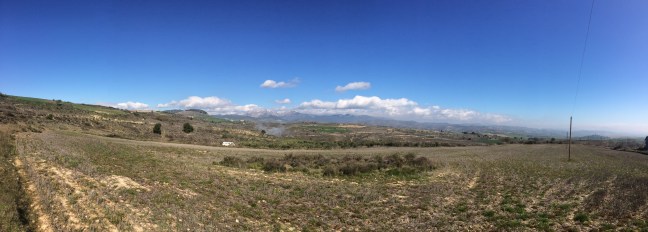
We found it cool, pleasant, and peaceful. A mountain range was always within view. Not too many farm animals or busy roads. It was nice and calm.

It is also a time to get to know people on the trail better. With less hills, people tend to congregate more while walking. You can start to learn more about the people you walk with and why they are on the Camino, where they come from, and share other life experiences.

We finished the day ahead of our remaining group and entered an albergue in which we didn’t know anyone. The people here were mostly a new batch of pilgrims from Burgos. Just as we were lamenting this fact, out popped our young German friend, Lisa.

She had stayed back in Viana instead of walking to Logrono. We didn’t expect to see her again. While it is disappointing to no longer get to see and talk with a lovely person you meet on the Camino, that’s the way it works. A common expression on the way is that “everyone walks their own Camino”. You never know who will enter your Camino or who will depart. You only have the moment you are with the person. It may last for a few minutes, a few hours, days, or the entire Camino.

As it turned out, the blizzard had proven too much for the group she was with and they decided to get a bus to the next town. The bus driver refused to take the pilgrims to the town for which they had purchased tickets and instead said he was going to Burgos no matter what.

So here we sat, very much enjoying the company of a person we thought we had previously lost.

I spent most of the night attempting to get pictures sorted onto the computer at the albergue. My laptop had deleted its OS so I was SOL with blogging. It would turn out to be a fruitless night.

Day 14: Hornillos del Camino – Castrojeriz

Distance: 21.3 km

Just like the evening before, I spent most of this morning trying to get our travel pictures blog ready. Elizabeth finally pushed us out of the albergue around 9. She was not going to spend her Camino waiting for pictures to load.

We were not the only group to get a late start. We opened the gate of the albergue and headed out onto the main street. Lo and behold there were our friends from Canada and Australia and I began to sing “Oh Canada.”

We walked with people almost the entire day. The Canadian, Aussie, German young man, and the two Sardinians. We had met the first Sardinian at the Arte de Kilometre. The second, from Northern Sardinia, had fallen in with our group once the Italian group broke up in Burgos. Tribes form, factions fall, and what’s left is a ragtag bunch of pilgrims.

Our Southern Sardinian knew English extemely well, the Northern Sardinian knew Spanish (and French) better so we had translators for just about any situation.

When we arrived in the city, the group broke off, with the Aussie, Canadian, and German all deciding to walk an extra 10 km. Elizabeth was not doing so well so we decided to stop where our book had suggested.

The Sardinian duo and Lisa also stayed in the same place with us. We arrived to the city a little too early to stop for the day, but we didn’t care. We were tired.

What we encountered next is typical of España.

Siesta was taking place when we arrived so we could not get food for dinner. The sign on the door of the only market in town said it would reopen at 5. When we went back to the albergue at 5:15 with no food, the hospitalero said it opened at 5:30. At 5:40, we found a local walking by the market who told us it didn’t open until 6. At 6:15 the store opened to great fanfare of five pilgrims, each but Elizabeth cursing under their breath.

Lisa and I had decided to join forces to cook some pasta dish while Elizabeth tried to figure out if/when mass was to take place. And while Elizabeth was gone to mass the Sardinians arrived to discuss dinner plans. We invited them to join us and thus began what I would like to call the “Camino tour of Italy.” This would turn out to be the first of many meals prepared by the Southern Sardinian.

While Lisa and I were fully prepared to figure out how to make the pasta, the Sardinians kicked it into high gear and made actual dishes.

Between the Sardinian duo and a little Camino magic, we ended up with two different pasta dishes. All made with a couple of cans of tuna, tomatoes, olives, noodles, olive oil and backpack pesto.

Now you might be wondering what is backpack pesto. Anything that someone carried for over a day, Elizabeth and I would dub it backpack XXXXX. So for almost the entire Camino I carried backpack olive oil and butter. The Southern Sardinian carried backpack salt. Some of the kitcken/cooking area’s we encountered did not have what you would need to cook, so those of us who didn’t want to spend $10 -12 euro a night on food would haul pantry staples around rural Spain on our backs. Most everyone carried backpack meat and backpack cheese.

By the time Elizabeth arrived back at the albergue, Lisa and I were dutifully cutting olives away from their pits as the Sardinians were figuring how to use an electric pot to boil water.

We ended the night with a pesto pasta dish and a tuna with tomato and olive pasta dish. What the Southern Sardinian could put together in a pinch was like a culinary Macgyver.

As we sat at the dinner table, winding down for bed, a man burst through the door of the albergue looking completely ragged, tattered, near toothless, and homeless. He carried a pack but did not look like most other pilgrims.

It’s because he was not like other pilgrims.

Thankfully we had two Italians with us to translate his story.

He had walked from Rome to Santiago. And now he was walking back. And it was his fourth time to do such a walk. He then showed us his pilgrim’s passports with all the stamps and his certificates. It was like rolling out scrolls. He had stacks of passports. His first certificate had been folded and unfolded so many times it was in four pieces.

He walked the first time for his priest, then for his mother and family, then for himself, and number four for God. I probably would have done number one for God, but that might be the cynic in me.

He stayed in donation based albergue’s so he was not required to give money. Many nights he slept on the streets. He covered 40-45 km a day. He volunteered at the Vatican when he wasn’t walking.

We sat in disbelief. His clothes were not dri-fit, quick dry, brand name, field tested for the most extreme conditions. He wore t-shirts and jeans. His backpack looked to be older than me. Yet here he was, in front of our eyes, making 800 km look like walking to your neighbor’s house.

We offered him our leftovers. He accepted only a small portion and thanked us profusely.

We went to bed full of pasta and full of wonder at the man who just kept walking.

Day 15: Castrojeriz – Fromista

Distance: 26.1 km

It finally rained all day. We had heard that it would happen at some point, especially in spring. Thankfully we had spent a fortune on top of the line hiking ponchos when we stopped in St. Jean. These are no ordinary ponchos, as they cover the extra hump of your backpack and still have plenty of length in the back.

Our Sardinian compatriots had failed to procure the same and were left to endure the rain with only a regular jacket and a single use poncho. The South Sardinian was soaked to the bone and the North’s poncho had disintegrated the moment a stiff breeze caught it. It shredded immediately and looked like she was little red riding hood in a fringed jacket.

The day started with a large hill that gave us beautiful views of the town we were leaving. After the large hill, the rest of the walking was easy dealing with the weather was not. The Camino walks are nothing like the hikes we had on the Appalachian Trail.

You cannot even compare the two adventures.

The Camino is easier in every sense with the exception of sleeping. On the Camino, unless you want to spend $50 bucks a night, you will end up sleeping in a room full of strangers. Pleasant enough people when awake, but hell on earth when snoring. You don’t hear that in the middle of the Georgia woods.

We took a long break about 6 km before our final destination in hopes of drying off. We commiserated with beer and croquettes. I think we would have preferred no rain to the refreshments.

We arrived at our albergue to find a common room similar to a nursing home. Plenty of older, cold, wet, exhausted pilgrims huddled in the common room to soak up the warmth of the fireplace. This wouldn’t be odd, but the fact that no one was speaking to each other gave the room an eerie feel. Luckily, we found out our Canadian had also stopped here as we saw her pants dangling from the clothesline (she wore exceedingly bright clothes).

Without a kitchen, we resorted to a meat, cheese, and wine party. We spent the night enjoying the company of our young, hip, English speaking group. The South Sardinian, the Canadian (who is presently living in Berlin without being able to speak German), and Lisa (who had been living in Ireland for the last year and has a Irish accent when speaking English. We are unsure if her German also has an Irish lilt to it).

Everyone seemed to be enjoying the good mood as we headed to bed. It turned out even the locals were having quite the time. As we tried to sleep, somewhere between the hours of 11 PM-5 AM, a marching band proceeded to prance around town, waking up anyone with ears. To add to the excitement, what can only be described as a cannon blast was heard several times during the night, although we never saw the aftereffects of whatever battle took place or was reenacted.

No one got much sleep. The midnight party is still a mystery.

Camino de Santiago days 7-11

Day 7: Los Arcos – Logroño

Distance: 29.3 km

When we woke up in Los Arcos, we had no idea we would meet another Dutchman who would steal our hearts. Unlike the older, grumpier Dutchman we had been coming across, this Dutchman was younger, much taller, and even more gregarious. He was quite the personality. At breakfast, he and his companions were regaling the albergue with a story about the extremely drunk Irish girls they had met the night before. He was an excellent storyteller. Although we were sure we would never meet this Dutchman again, our paths would cross a few more times throughout the Camino.

We finally left storytime with the Dutchman to begin walking and found the day split in half between a pleasant path to a wild city and a dirty path to a milder, larger city. At around the 20 km mark, we arrived in the town of Viana. It’s a popular stopping point for those who do not want to walk the long stretch to Logroño.

IMG_1509
View

As we entered the city we could hear extremely loud popping sounds, like a gunshot. We were unsure of what it was, but we knew we didn’t want to be anywhere near it. Too bad. The Camino path rolls right down the center of town and into the madness. It was the Saturday before Easter and it was a big day for the 18 year olds in the town.

As the story goes, the 18 year olds will soon graduate and move into the adult world, military or something else that involves responsibility. But on that particular Saturday they run around the city shooting off fireworks, blowing whistles, and getting as drunk as possible. But they didn’t drink and shoot fireworks in one designated section. They roamed around the city and took the party with them.Their mode of party transportation – grocery carts. Someone pushed a grocery cart full of fireworks and another pushed a grocery cart full of liquor. It was quite the sight. We think they were also raising money for charity, but it could have also been more money for booze and/or fireworks.

We sat for a moment to enjoy the mayhem and some ice cream then continued on our way. We should have stayed longer. The next several kilometers just past Viana were awful. Hot, dirty, truly awful. We discussed the different ways in which we would probably be robbed or mugged by teenagers on that section of the way. Alas, we made it to Logroño in one piece.

At this point I (Clay) should tell you that my father had been texting me everyday, probably to ensure we were not dead in a gutter in rural Spain. He started by asking where we were each day and I would respond with the city we were headed to or had stopped in for the night. If the city name was too long to type, I sent a picture.

He then commenced to look up everything he could find about the city and tell us what we needed to see and do.

“Did you get a picture of the castle?”

“What about the church? So and so died there.”

“You should go here for dinner.”

“Stay in this hotel.”

In Logroño, I gave in. For dinner, we headed out to find a restaurant my father suggested. It made great sense… Trust a man whose idea of Spanish food is a taco with a Spanish dinner suggestion. We had dinner at the suggested restaurant – Burgerheim. It was a burger shop that took inspiration from art museums around the world. I think we had the Mondrian and the Picasso burgers. Interesting note: You could choose the meat for your burger at this restaurant. We chose beef, but they had pony. If we had been feeling better we would have tried it.

Our food ended up being very good. It turns out, trusting your dad’s restaurant advice from halfway around the world is a great idea.

Day 8: Logrono – Najera

Distance: 30.4 km

A tale of two days

The walk this day was wonderful. We met, walked, and talked to a lot of people on this day that were integral to our Camino experience. The morning of Easter Sunday began with a quiet walk through the vacant city of Logrono. It was calm and covered in trash. I picked up a plastic rose and gave it to Elizabeth for her backpack. I’m such a romantic.

We began the morning walking with a couple of Danes. We walked with them for about 6-8 km before taking a break. At this point we met our young Canadian. A most humorous woman from Newfoundland.

I’d like to think she took a shine to us because I am one of the few people who know where Newfoundland is located on the globe and because I can pronounce it correctly. You don’t say found in the word, you should say Newfndland, ignoring the vowels. Although, she probably just liked us because of our bag of Doritos.

When we took another break, we ran into our Australian friend again. We believe this is the best thing about the Camino. You can run into all types of people at all point on the Camino at any time of the day.

From there we walked a little further to the option. Many days on the Camino have offshoot routes allowing you to find neat and interesting buildings or cities just off the main trail. These paths eventually run their way back into the main path, only taking an extra 2-3 km.

This detour was the Arte de Kilometer, or Art Kilometer. As we were staring at the sign trying to determine the merits of the extra km, a young woman was sitting underneath the signs taking a much needed break. She listened to Elizabeth and I banter back and forth, with the conversation heavily laden in sarcasm, about what could this kilometer possibly hold. After a few minutes of talking, I asked the annoyed bystander if she knew anything about the art, if it was worth it, if she was going, and if she wanted any chocolate covered peanuts.

She looked at us with a smiling, annoyed face, shrugged her shoulders and said she didn’t know. And that she did not want any peanuts. Not satisfied with the first answer, and the realization that she spoke English (so she understand our entire ridiculous discussion), I pressed her to commit to a decision and tell us what we should do. She did not acquiesce.

So away we went, headed down the Arte de Kilometer. We discussed how stupid we must have sounded to that stranger. As we entered the town in which we were detouring to, we encountered no art, but something much better. Almost all the people we had been walking with or seen frequently over the course of the last week. The grumpy old Dutchman, the energetic Danish man, the Aussie, our new Canadian friend, lots of Germans.

It was like a mini homecoming. Not knowing anyone halfway around the world can be a lonely thing, but seeing familiar faces makes everything seem much easier and keeps you relaxed. We sat down for a bit and enjoyed the company of the strange collective of individuals from around the world.

We headed out before anyone else, since our pace tended to be a bit more glacial than others. And who did we encounter, our Art bystander. She was struggling and limping, suffering from extremely battered feet. We offer her more peanuts, she declined. She did ask about the Art Kilometer and we told her we saw no art and she was better off taking the short route.

We continued to enjoy the walk until we arrived in Najera. We could not find an albergue to stay in. The first we stopped in only had a private room at $50 bucks. We had been paying $10-15 a night, sleeping in the large rooms, and didn’t want to spend that kind of money on a single night. Elizabeth began to walk around the city and realized that all the other albergues in our guide book were closed or out of business. So we sat down on a bench stewing and angry, wondering what the hell we were gonna do. Elizabeth was mad, which rarely happens, so I volunteered to walk around the city until I found the municipal albergue, our last hope. I began wandering the streets, completely lost, looking for any sign.

Then the happy Dane showed up yet again. I jogged over to him. He said he and his group were headed to the municipal, it was right around the corner and we should join them. He was the kind of person who always popped up when you needed your spirits lifted or needed anything. There at the right time, with the answer or an ear, or a kind word. I found Elizabeth, hoping I had salvaged the day, and we made our way to the albergue.

Turns out the day was going to get worse. As we checked into the albergue, Elizabeth asked about mass times in the city. In a town of 8500, they had three churches within a few hundred meters of where we were staying, typical Spain. Except it was now 5 PM and all the masses for the day were over. Elizabeth missed Easter Sunday in a country that treats the holiday like a religious Super Bowl. What continued to make it worse was that we had been tracking Semana Santa (Holy Week) across Spain. They began setting up in cities at the beginning of March and had advertisements about it the entire time. We had to walk around stages and closed roads in Sevilla. We saw processions practicing in Segovia.

So not only did Elizabeth miss mass, she missed the biggest, bestest, most celebrated Mass of they year. I have attempted to come up with a proper analogy to explain a similar situation and have failed.

We had gotten up in the morning in a town full of churches, walked through other towns filled with churches, all having mass while we were walking, and finished in a town filled with churches. Yet, we could not make it to a single mass that day.

Elizabeth cried for a while and we went out for gyros for dinner. We sat alone in a gyro shop in Najera Spain on Easter Sunday. Conversation was limited. We went to bed after dinner.

And that completes Semana Santa for the Cornelius family. To this day, Elizabeth says this day is her most AND least favorite on the Camino.

Day 9: Nájera – Santa Domingo de la Calzada

Distance 22.8 km

The day Elizabeth tried to kill Clay is how I would describe today. It was a walk with not much to see or do or visit.

It began with me losing my cellphone. After each of us checked our sleeping area multiple times and unpacked my backpack twice to make sure I didn’t do something stupid, we determined that someone picked it up on accident or stole it. Either way, we were about to be the last people to leave the albergue. I was angry at my stupidity and Elizabeth was annoyed at my stupidity. Our last ditch effort was having an albergue volunteer, with international calling, try to reach the person who had mistakenly picked up the phone. It worked. We heard the phone, vibrating… in Elizabeth’s backpack. She accidentally packed the cellphone in her sleeping bag and shoved it down in her backpack. Not a great start, right.

IMG_1588
The people who helped find my phone

After about 6 km we ran into our first town. Just before the town a golf course appeared. We decided to stop in for a bite to eat and I thought I could find my Father something from the pro shop.

As I entered and began meandering, a young woman began to follow me around the 12×12 foot room. As I tried to figure out if the store had any men’s clothing, the employee approached me. “Sir,” she says, “this is a golf shop. We don’t have anything for pilgrims.” I looked at her, a bit confused and then I realized she thinks I’m some poor, stupid pilgrim trying to find outdoor gear in a room full of overpriced ladies polos and golf gloves.

I could not find any mens polo’s, hats, or golf balls with the club logo, so we had a bite to eat and left. With not many other places to stop on this day, we trudged along with few breaks. Finally we were within 2 km to our destination and I needed a break. Elizabeth was having none of it. I explained I needed five minutes to sit and regroup. I was exhausted, not feeling well, and would have liked to rest.

She reiterated that we were only about 15 minutes away from where we were staying and I should suck it up. We were almost there.

With 1 km to go, I stopped. I told her I needed some time and I didn’t care how much further it was. There was always a place to stay, all the stores were closed for siesta (or Easter Monday) and there was no sense in trying to kill me to arrive in a town for which there is nothing to do ten minutes sooner.

She allowed me to rest. All I could think was that she had turned into a sadistic taskmaster hellbent on making me suffer. She became the Russian from Rocky, “I must break you.”

I was in worse shape when we arrived. Too ill and weak to cook, we argued over dinner ideas and settled on frozen pizza since our albergue had an oven (a rarity). We went to bed unhappy and exhausted, debating if the walk was a good idea.

Day 10: Santa Domingo de la Calzada – Belorado

Distance: 23.9 km

It was not a good idea.

I got worse. I slept through the night but woke up in the morning covered in sweat and feeling like death. My legs and feet were fine of course, but the rest of me was crumbling.

For breakfast we enjoyed leftover pizza, while being watched by the Sardinian who refused our peanuts a few days before. As an Italian, she was judging our breakfast choice as we squeezed bbq sauce over our chicken pizza. Of course, she was eating Oreos. On the Camino, anything goes foodstuff wise. Beer in the morning, cookies all day, chocolate bars everywhere. We even witnessed a guy uncork a bottle of wine in the morning so that he could drink it while walking.

We left at the last possible moment as a terrible volunteer was walking around ringing a bell in everyone’s face who was still struggling to exit the albergue.

I was immediately exhausted. We had not been drinking enough water, eating well enough, or sleeping with any consistency.

The weather was also not cooperating. The wind was howling, so much so that we put on our ponchos to protect ourselves from the wind. I threw on my hood to protect my ears from the constant rush and loud noise formed by the gusts. At one point, Elizabeth was leaning into the wind and it was preventing her from falling over.

I had to stop in every city we walked through, each time debating if this was as far as I could go, struggling to drag myself off the ground long enough to walk another 3-4 km.

About halfway through the walk, I gave up. I shook my fists at the sky, cursed the wind, threw my trekking poles into its whirls, shed my pack, and fell down in a field. I could not take anymore. I could not handle another step.

After a while, maybe 30-45 seconds, I regrouped and regained my composure. I explained to Elizabeth that I needed a nap, obviously, and had no desire to see, talk, or sleep next to anyone else the rest of the day. I was peopled out. I needed to be alone.

We managed to pass a few groups, notably the Italians, who tended to be at the back of the pack, stopping in every town to have a beer, drinking merrily along the way. As we arrived in another small town, we found a spot to rest in the shade of the first building in the town and laid down . We watched every group pass by us as we drifted off to sleep.

When we awoke 15-20 minutes later, we knew we were behind everyone else. We grabbed our stuff, turned the corner and to our surprise saw a group of 5-10 backpacks. We had been laying in the shade of a bar/cafe/restaurant where the Italians sat, finishing up another round of beers and bocadillos. We felt silly about stopping where we did when there was a perfectly fine place to stop and rest with food and drink on the other side of the wall. This became a theme for our Camino experience, walk a few feet further and it will probably pay off.

We eventually made it to Belorado. To give ourselves a chance to regroup from the tiring day, we stayed in a Pension, which is basically a B&B for pilgrims. It was a completely different experience than staying in an albergue. We were not herded in. We were not made to get out our passports immediately and then pay. It was like staying in a real place. The owner said to take our time, go relax, have a shower, take a nap, and when we crossed paths again, we could discuss all the particulars.

This saved our Camino, especially for me. Our own private place away from the other pilgrims. Our own bathroom to shower in. Robes to wear. We might as well have been at the Ritz. They did our laundry and provided us with information about the next couple of days walking.

It was exactly what we needed when we needed it.

Day 11: Belorado – Ages

Distance: 30.3 km

We awoke refreshed and ready to join the huddled masses again. We were served a lovely large breakfast, one we didn’t have to fix ourselves. We had been warned the night before about the threat of snow, a persistent concern during spring, but it turned out to be a perfect day. The weather was amazing and the walking was not too difficult. The day was all uphill, but a gentle slope. A stretch of 8 km breezed by as I talked to a young Danish kid.

We felt so good we decided to ignore our guide book and continue an extra 3 km to the next town, Ages. There were still whispers of the threat of snow and we wanted to get ahead of it if possible.

We arrived before many others and found our albergue to be lonely. All the other people we met on the way stayed at other places that night. Luckily, the grumpy Dutchman appeared out of thin air at dinner time. He was walking around the city checking in on anyone he recognized.

As he walked in, he began to talk to the albergue hospitalero, the person in charge of the albergue, in Spanish. We knew he could speak English in addition to Dutch, but we didn’t know he knew Spanish too. When we questioned him about it, he rattled off a list of other languages he could speak (6-7 European languages), but noticeably absent was French. He said he refused to learn French as he did not care for the French people and their way of life.

It was yet another reminder of our inadequacies as Americans abroad. We know no other languages. Everyone we met that was not Anglo-Saxon, knew at least two languages, most often English as their second language. Had it not been for other people working hard to learn another language, we might have been left to only talk to the Canadian and Aussie.

We closed the night playing a few card games with an Irish group of eight. They taught us a game or two and we taught them a couple of games. We all laughed and spoke English although some phrases and the occasional number had to be translated or said more slowly so the other nationality could figure out the other’s English.

The Camino Continues…days 2-6

We are still working out how we want to write about the Camino. There is so much to say about the 30+ day adventure. Below is the easiest way we thought to organize the trip. 

Day 2: Roncesvalles – Zubiri

Distance: 23.1 km

The first few km of day 2 were also full of snow/ice. The benefit of leaving at 6:30-7 AM is that the sun is not all the way up yet so the snow was frozen enough that we could walk on the deeper sections to avoid the iced over patches.

At lunch time we stopped in a little market to buy ingredients for a road sandwich. A road sandwich is something that I (Clay) would often make for us when we drove from Atlanta to Birmingham and didn’t want to stop to eat. It is exactly what you might envision a sandwich to be – lettuce, tomato, cheese, deli meat, mustard, etc, but it was perfectly delicious while driving and great for walking too.

A camino road sandwich is a little different. On the camino you work with what the market give you. This particular market provided pan (bread), chorizo, queso, and peppers. All that we lacked was a knife to cut the bread in half. The knife we found in the market was a 1.50. Surprisingly, when we made it to the cash register to pay, the price jumped to two Euros.


This was not a fancy knife or pocket knife, but a knife you would cut your pot roast with on your plate on Sunday afternoons. It was not a sharp knife or a good knife, but now it was ours. When Elizabeth sat down with all our sandwich goods so I could start making the sandwich, the knife slid off the edge of our perch and about ten feet down into a briar patch.

Much cursing was done and I headed down to find the knife, but to no avail. Great way to spend two euro. We bummed a knife from some other pilgrims and made due. Eventually Elizabeth headed down and after several minutes she found the knife (It should be noted that as of 4/27, we still have the knife, around 40 days hauling a crappy knife across all of Spain).


Day 3: Zubiri – Pamplona

Distance: 22.7 km

Every 3-4 km on the Camino, there is a town/village to walk through. It allows pilgrims the ability to pack light on food and buy as they go. There are also cafe’s in these towns that allow pilgrims to break for a hot or cold bocadillo instead of buying from a mercado.

We were buying fruit and also stuff to make sandwiches. The trail mix/cocktail mix is disappointing in Spain. They use fried corn kernels, never add raisins and include pistachios…still in their shells. It’s terrible.

The walk this day ended in Pamplona, a city we had already visited.

We slept in another huge albergue, hosting around 150 pilgrims. We met a German girl with an Irish accent, done so to hide the fact that she is German.

She had to endure the first Camino couple we encountered. It happened to involve the Spanish man we met our first night at dinner in Roncesvalles and a seemingly lonely Irish woman. We escaped most of the canoodling while we were out, but our German friend got to experience the sights and sounds of middle aged strangers making out.

When you walk the Camino this time of the year, the crowds tend to be small and you recognize everyone. We would see these same people many times over the next week.

For our dinner, we headed out for pintxos. It is the Basque (yet another divided culture in Spain) version of tapas. It was fine and we enjoyed ourselves, but as we were walking home the streets were filled with the sweet smell of pastries.

We headed into a candy shop, but quickly realized they made nothing and we were in the wrong place. Back on the street we noticed a line had formed in the middle of the road (it was a pedestrian street so no cars would get in the way of the line). We didn’t know what was being served, but thought it must be good.

The line continued to grow behind us and we finally figured out enough information to determine that the shop we were waiting to enter is a famous pastry shop in Pamplona that makes a specific pastry, serves them hot, sells out often, and people buy these pastries by the kilo (which is 2.2 pounds).

We waited 45 minutes to enter the store and were hit with a huge bout of panic as it seemed we were going to have to buy a kilo or more of pastry. That would have been fine on any other trip, but we did not want to haul pounds of pastries up and down mountains.

Of course after eating the pastries, it would have been worth it. The pastry in question was nothing special. It was a small rectangular shaped croissant filled with chocolate. What made it special was the pastry is served hot and fresh like a Krispy Kreme so the chocolate in the middle was melted and still very warm.

We regretted only getting six croissants. We saw others buy 5+ pounds.

Day 4: Pamplona – Puente La Reina

Distance: 25.5 km

Today was split in half. The first half was climbing the mountain. The second half, climbing down. The climb was not as bad as we thought, especially in comparison to our first day on the trail.

The walk was fairly windy (curvy) and very windy (breezy) on the way up the mountain. Although we didn’t stay on the top long, we were surround by amazing wind turbines and a nice set of Camino sculptures. On the way down, we ran into the German girl we met in Pamplona again and a Hawaiian woman (our first American) who had just retired and was looking for adventure. We walked with them for a bit and carried on.

We arrived early to the town and found the albergue for which we had decided to stay. We were in a room full of five Irish girls and later, the same German girl.There were many Irish pilgrims early on in the trip who were taking advantage of Ireland’s long Easter holiday.

The Irish group was doing the Camino in a different fashion than most of us. This particular group of Irish girls sent their backpacks ahead to whatever city they were walking to the next day so they carried nothing on the trail. It is not incredibly uncommon for people to walk that way, particularly older or wealthier pilgrims.

These girls had packed all the essentials for walking across rural Spain. It mostly consisted of outfits and make-up.

Later on in the evening, a group gathered in the albergue common room and talk drifted to European politics. The talk took place between an older Dutch man, a young Dane (who was walking the Camino in 25 days, which is sadistic), and our German friend. It was a great look into people’s perceptions of the situations happening all over Europe.

Thankfully talk stayed away from US politics for the most part, although the Dutchman made it well known that he loved the US and everything it stood for. He also turned out to be an extremely colorful individual, one we would encounter several other times.

Day 5: Puente La Reina – Estella

Distance: 23.4 km

We were awoken very early in the morning and were not happy about it. The Irish girls were up and moving around at 6 AM. Now most albergues ask that you exit around 8 AM. Some of them are nice about it, others not. No one asks you to leave at 6. We still cannot figure out why the Irish girls wanted to get up at 6 AM to walk without backpacks. It is an easy walk most days and even easier without having to carry anything.

For some reason this day, I (Clay) had a rough day walking. We took a really long time to cover a shorter distance. We had lunch really early that day. I took a nap because I felt awful and managed to sweat out whatever was ailing me. I am assuming it did not help that the day was very sunny and we were still not drinking enough water.

I recovered at dinner and made spaghetti and meatballs (from scratch). I know at one point on this trip I revolted against any bocadillo with jamon or chorizo (not the good kind, the Spanish kind) and refused to eat another.The meal turned out great and we enjoyed it with the South African/Canadian friend we had met a few days prior.

Day 6: Estella – Los Arcos

Distance: 23.3 km

We took the long way today. It was supposed to be more scenic and have a peak for better views. We were dragging again so we didn’t get far fast. Elizabeth was having a slow day even in spite of the wine fountain.

In the 90’s, the 1990’s, a winery located in a closed monastery began to offer wine from a tap. They also offer water, but I think it is much less popular. The wine was red and it drank.

We spent the night at an albergue run by Austrians. This was well known to the 10+ Germans that chosed to stay here, but not to us.

Since it was Good Friday, the city was having its Semana Santa procession. It starts in one church and ends in another, some 5-600 meters from one another.

The outfits were colorful and klan-like. The traditional outfits predate the KKK, but it is quite striking to see these outfits being worn in the street on purpose. There are miniature chocolate and white chocolate figures that can be bought in the local confectionery shops. We did not indulge.

That almost sums up our first week on the Camino. Stay tuned for the next installment of the Cornelius Camino. 

Snowy Mountains and Saving Souls

We assume those left reading the blog have looked up the Camino de Santiago by now. In case you are still in the dark about it, the Camino is a pilgrimage to Santiago de Compostela where St. James the Greater, who was one of the 12 apostles, is buried.

There are several walking routes all over Europe ending in the city of Santiago de Compostela. We chose to do the Camino Frances. It is the most popular and well travelled (for us that meant safest for only English speakers) of the Camino’s. From St. Jean Pied de Port, France, it is 30-40 days of walking depending on your walking speed.

Some of you may be familiar with the Camino due to the documentary about it a few years ago and/or the Martin Sheen movie about it. We have seen the doc, not the movie.

We can’t remember when or why we decided to do the walk, but somehow it ended up on our travel itinerary.

Day 1: St. Jean Pied de Port – Roncesvalles

Distance: 23.6 km, including elevation 28.5 km (Sidenote: We won’t be converting kilometers to miles in our blogs. To better understand how much we are walking – 1km = .62 m. So 10km = 6.2 m, 20km = 12.4 m, and 30km=18.6 m.)

This was the hardest day of the Camino for almost everyone.

We began day one leaving St. Jean Pied de Port headed to Roncesvalles, Spain. Everyone gets an early start at the beginning of the Camino, often rising at 6-6:30 AM. We left around 7:30 as we were not aware of such departure times. We had covered 200-300 meters before stopping for pastries. Probably not a great idea, but who knows when you will be in France again.

After a croissant and pain au raisins (which was incredible and the best pastry of our two months of travelling so far), we were back on the road and ready to cover the other 28+ km.

No rain the first morning as we walked through the French countryside. Some of the walking is on the road, albeit very narrow rural roads. Much of it through mud/dirt paths. Our sights consisted mostly of valley views, cottages, and farm animals. The trail also followed the river dividing Spain and France so we trekked back and forth between the two countries for a bit in the morning.

Once solidly in Spain and having covered a few km’s, we stopped at the first supermercado we encountered. We had not brought sunscreen on the trip and the day was proving to need it. We bought what we needed and had our first conversation with a pilgrim on the same path as us.

She was English and carrying a larger pack than either of us. That was a bad sign as I (Clay) knew my pack was already too big. Elizabeth and I discussed whether or not we would see the woman later that day because the hike is extremely strenuous and she was already having a rough go at it.

Content with our sunscreen, we carried on. The countryside was lovely. We enjoyed being out in nature, away from large cities and traffic.

And then we began the ascent. The hill begins at 5 km but doesn’t start getting steep until the 17 km mark. And it doesn’t stop getting steep until the top of the mountain, km 23. The entire 6 km was also covered in snow/ice. So for every three steps you took, you really only took two because you slid back a few inches each step. For some of the more snowy portions, there was no place to take a break, to sit down, to take off your pack. So you just kept walking, waiting on the opportunity to drop the pack. I managed to find a limb to set my pack on to grab a few seconds of air.

Since Elizabeth walks hills at a slower pace than me, she caught up with me just as I was ready to start walking again. We discussed how difficult the walk was and then started walking again. Further, longer, steeper, and finally out of the snow for a strech, I sat down in the middle of the trail. I was spent.

By this point we had covered 12-13 miles, the last several all uphill. I pulled out my water filter and started drinking water running directly down the trail. I knew with the filter, it wouldn’t kill me. I also knew if I didn’t drink any water, I might die on the trail.

We also failed to eat anything of substance during this entire stretch of walking. Stupid we know, but we did not consider that for several miles we would be abandoned and left for dead in the Spanish wilderness (there was a clean, cleared off road only a 100 feet to the right of the trail that we later found out most people walked on because the snow was too challenging).

Eventually we made it to the top of the mountain, the last few feet crawling because the snow was too deep to walk through without falling or getting stuck.

At the top we were ecstatic, having covered all but 1 km left of our walk/hike for the day. We were exhausted, completely gassed. We celebrated for a few minutes and turned towards our final destination as a van pulled up at the top of the mountain. We don’t pay much attention to the van, but as the sliding door opens up, we see a familiar face. The English woman.

She locks eyes with us and we can tell she is embarrassed. She starts talking to us, and we are all laughing at how we all made it to the top of the mountain at the same time. She mentioned how she didn’t think she would use her “get out of jail free” card on the first hike of the Camino.

We didn’t mind that she cheated and she was disappointed that she was unable to climb the mountain. Of course, we were proud that we had worked our asses off to hike what we had set out to do. And a little annoyed. But that is not what the Camino is about.

We made it to our albergue and ended up staying in the same four person bed cube as the woman. We also were with an Australian woman who we got to know later on the Camino.

We both needed showers but had failed to pack a towel. We thought the places we stayed would have clean towels we could pay a euro or two to rent. Nope. So Elizabeth toweled off with her long underwear. Clay airdryed, after squeegeeing as much water as he could off his body. Shortly after we put “Buy a towel” on our to-do list. 

We had dinner later than most other pilgrims so Elizabeth could attend mass at 7. Since it was Palm Sunday, mass started outside in the church’s crypt. Elizabeth followed the procession to wherever the congregation and priests went. I stayed back sitting on a rail somewhere outside of the church waiting for the congregation to rejoin, bitching internally at the cold temps, choice of shoeware (flip-flops since I had just taken a shower), and anything else I could find to complain about.

And then I heard it. A loud banging sound. And again. And again. “God is that you?” I thought. Surely not. Sounds more like a door. And I follow the banging to a large wooden door. A door with people behind it. And the door is locked. Thankfully one of the individuals spoke English because I explained in my best Spanish that I only knew English. I also explained that I understood they were locked behind the door and did not need further information, especially in Spanish.

So I found a man who looked to be working at the church and attempted to explain to him what was happening. He told me he understood English, but after I explained, he explained that what I said was impossible. And he explained it to me with many hand gestures and in Spanish.

I explained again more slowly in English (which never works), and commenced to drag the old man over to the door so he could unlock it. Out popped three poor, unhappy souls whose only reaction is to walk off and leave without so much as a thank you to anyone.

That’s the last time I help strangers locked behind a large door.

Church was relatively normal but at the end the priest prayed over all the pilgrims. It was humbling to hear him pray for all of us in our native tongues. He prayed for us pilgrims in in Spanish English, Italian, French, etc. Although we still didn’t understand all of mass, we did understand the pilgrim prayer.

After mass we headed to our first pilgrim dinner. It was underwhelming and we tried to avoid this as much as possible in the future.

We eventually made it bed, ready for day two. The hill on the first day is known to be the worst you will face the entire Camino. Athough we were a little tired and sore we knew we could walk any day from that point on.


We Are Pilgrims on a Journey…

“…We are Travelers on the Road…”

After our stay in Barcelona, we left early in the morning for France and our new adventure – Camino de Santiago. Our train from Barcelona ended in Pamplona and the bus awaited us. While waiting for our bus to leave, we stopped in the Spanish post office, Correos, to forward most of our luggage to Santiago. Because we are carrying our clothes for 6 months and for various seasons, we needed to forward our luggage to the end so we didn’t have to carry it on the Camino. Basically, no one has any business carrying much with them on the Camino.

An hour plus later, with the help of four non-Inglés speakers, we managed to pack up a box and a large suitcase to send along to the finish line. Once everything was packed up, and by packed we mean wrapped in plastic wrap and taped up, we realized that we forgot to include the unnecessary binder full of travel paperwork. It was missed in the shuffle and with the amount of tape used to secure our box and luggage, the 2+ pound binder would have to travel some 500 miles on Clay’s back.

No big deal of course because we had decided to carry only what we would need for the trip in our packs. Of course, for some reason, Clay needed a hardback book and a paperback around 400 pages.

Now we know what you are thinking: “Clay, they make this thing called a kindle/nook. You should have invested in that instead of real books for this trip.”

And Clay’s response would be that he also has a kindle in his backpack. Now you know why his pack weighed around 30 lbs when it should have weighed 20 at most. He carried things he wanted and not just what he needed. The motto in Elizabeth’s family has always been “If you can carry it, you can bring it.” Clay may have taken that to the extreme.

But back to Pamplona. We walked around a little in the rain with not much success and headed down to the bus station to make sure we were in the right place at the right time.

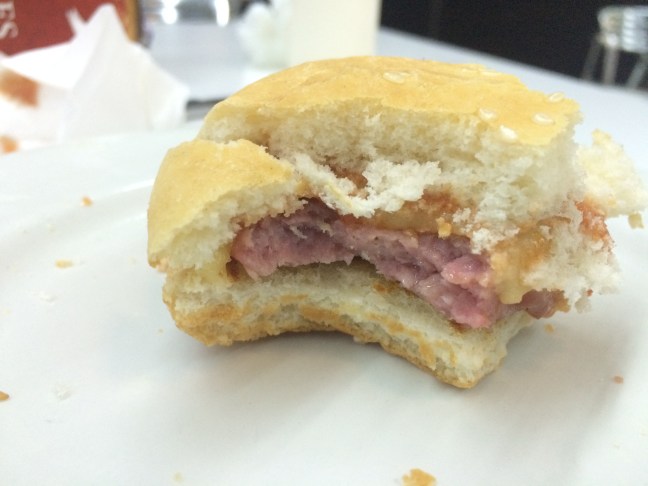
We had not eaten yet and were hungry. Luckily the bus station had several restaurants. But only one open due to construction.We ordered a hamburger and suffice to say Elizabeth refused to eat what was ordered due to the odd color of the meat.

I (Clay) ate it instead with her looking on in disgust, anger, and concern. Disgust and anger that I told her that for what we paid for the burger someone between the two of us was going to eat it. Concern because she was certain that the burger was going to make me ill.

IMG_1122

I took every pill from the collection given to us by my mother that I thought would be necessary to prevent me from dying. Thankfully it worked. That or the burger was not in fact poisoned.

Once we got on the bus, things cooled down. We were pleasant and amicable and then worried about our decision to begin the Camino.

The bus ride is 2 hours of winding mountain roads leading you into France while crossing the Pyrenees mountains. While sitting in the bus, trying not to get too queasy, we were passing pilgrims walking along the road. These poor souls were wearing the best weather protection they could find and were still soaked to the bone, having walked for hours in the rain. And that is what we had to look forward to the following day.

Once we arrived in France, we headed to our first albergue. An albergue is a type of hostel where only pilgrims are allowed to stay. We were the only people spending the night in ours. That’s because it was not supposed to open until the next night. I guess we missed the sign somewhere. It would be our last good night sleep for many days.

We settled in our albergue and headed to the city office assisting pilgrims starting their journey from St. Jean. An adorable French woman, Charlotte, assisted us and let us know, in French, that only one route was available for hiking tomorrow. The Napoleon route was closed after a couple of pilgrims had to be helicoptered off the mountain after getting stranded. Instead we had to take the Charlemagne route, a shorter, but much steeper climb.

Once Charlotte sent us on our way, we headed to find full length ponchos. We had brought rain jackets, but after seeing those lost souls earlier in the day, we knew we were going to need something more robust to protect us and our packs (filled with books).

We didn’t know what to do or where to go after all this other excitement, so we walked around the city, taking pictures in the rain of old stuff. And to celebrate France, we headed to any pastry shop we could find still open.

We found a single place open and ordered dinner, and apple tart and a raspberry torte/cake.

And while trying to find some sparkling wine to celebrate France, we encountered what appeared to be a female biker gang. These women were all dressed in black, looking terrifying, with one of the women having face tattoos and short spiked hair. An ominous looking group, we made it a point to walk across the street to avoid bypassing them a second time.

However, they chose to leave the bar at the same time we were walking by and they crossed our paths again. Elizabeth and I awaited the worst: hateful comments in French, possible assault, something else nefarious. Once the face-tattoed woman got closer though, we realized things were not as we assumed.

The hair was a wig. The face tat’s were temporary, taken probably from a cracker jack box or a quarter machine. The women were no longer looking scary but silly, laughing and wildly gesticulating and wearing matching shirts with a picture of an adorable four year old from 1986. The pieces came together and we realized it was a bachelorette party.

You can’t be to careful in France though.

We headed home, enjoyed our pastries and went to bed, ready (or so we thought) for the next 30+ days of walking through Spain.


Figueres: We regress

Figueres is a fine town. It is host to the Salvador Dali Musuem. He designed the building. It has a large collection of his artwork and his jewelry work as well. When you see his very early work and non-surrealist work, you realize he had an amazing talent. There were a few small paintings in the museum which showed his ability for more mainstream artwork.

All in all it was a neat look into an odd artist.

After the museum we changed our tickets to an early return and headed back to Barcelona to get packed and ready to go before we started the Camino de Santiago. I (Clay) cooked vegetables for dinner and we went to bed. That sums up the day.

But back to the disaster alluded to in previous blog posts.

We had train tickets for 8:20 (2 tickets) to head out to Figueres. We normally walk to the train station. Sometimes we take the metro/subway. Sometimes we take a cab. Obviously it depends on the city and if we are carrying luggage. We also normally leave our apartment with enough time to do two of the three. So if it takes 30 minutes to walk or 15 by cab, we leave 45 minutes in advance in case we make a mistake. That is very early, but the extra time is built in to resolve any snafu’s or blips with bad directions, traffic issues, or whatever problems might arise. Travel is expensive and paying twice is painful.

7:15 AM: We left the apartment around this time and began our walk to the metro station. It was a 45 minute walk to the train station, but we were taking the metro, which should take less than 15 minutes. A car would take 20 minutes.

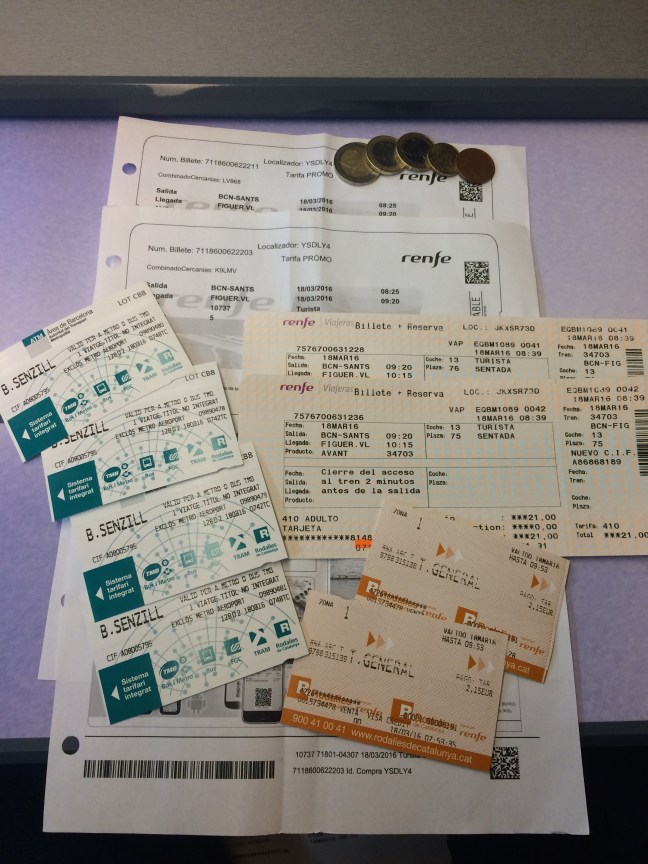
7:20 AM: We arrived at the metro station and bought our tickets (4 tickets). We went through the gate and began walking. Soon we realized we walked to the wrong subway line and needed to get to the correct side of the station. Of course the only way to do this was to buy new metro tickets because the other side of the train station runs different lines. So we bought another two tickets (6 in total) and walked to the other side of the same metro station. The tickets did not work. They don’t work because even though this is the same station, the R line and the L line use different tickets. This is the first station we have encountered where such an occurrence happened.

Fine. Whatever. Let’s just get on the train. So we bought yet another set of tickets (8) and started walking to the correct train line.

7:45 AM: By now it was closer to eight which was not ideal but not a problem. We could still make it on the subway. And if worse came to worse, we could still get there by taxi. We got on the train and headed off… in the wrong direction. We realized we were on the wrong train before the first stop. The problem is the first stop in the wrong direction was extremely far away. So far away that I realized we were toast because it’s now around 8:05.

8:05 AM: I decided let’s just take a taxi. Odds were we couldn’t mess that up and hopefully we could get close to being there before the train leaves. Also, the next metro train that was going in the correct direction wouldn’t be arriving for another five minutes, and we had messed up the metro so many times I didnt’t want to risk it any more.

If we had taken the metro, we would have likely arrived at the train station between 8:15-8:20. Probably with not enough time to get through security, but you never know. The big downside is the trains in Spain always, always, always left on time.

Of course in my haste, I forgot that the metro was faster than the taxi. So as we hailed a taxi and got in, I checked traffic. It was 8:05 and we were so far away from the train station, since we took the subway train in the wrong direction, that the traffic report says it would be 8:24 before we can could there for our 8:20 train to Figueres.

I (as if anyone is surprised) was lost in a fit of anger.

Our cabbie was driving as slow as possible. I could only assume to further enrage me. To make matters worse the song playing on the radio was none other than Rick Astley’s “Never Gonna Give You Up”. Life was rickrolling us.

8:29 AM: We arrived at the train station. Between morning traffic (how could there be traffic at 8 AM when no one goes to work until 10) and the cab driver stopping at yellow lights expecting them to turn to red at any moment, we missed our train.

I went to ask the train people what my next steps were. The said, “Buy new tickets.” So we bought yet another pair of train tickets (10).

10 tickets (6 of which were not needed), a 20 dollar cab ride, and untold sums of money wasted on those extra tickets to get to a city an hour away. What should have been a seven minute walk and 8 minute metro ride turned into over an hour of pure hell. And complete incompetence on our part.

We boarded the train separately as we parted ways once we got our final set of tickets. We had been together for the last hour. We each played a part in missing the train and each needed time to recover from feeling like an idiot. If we had been forced to be together any longer that morning, we probably wouldn’t be together now.

IMG_1111

Barthelona day 4: This whole city is Gaudi

Today was a day devoted entirely to one man, Antoni Gaudi.  The most famous architect of Barcelona, probably Spain, and pretty well known around the world.

We began with his most famous house, Casa Batlló. Much of the audio guide made mention that the house has no straight lines.  While not entirely true, the architect tried very hard to avoid any straight lines. It is a magical building. Floating, dreamlike, wondrous.  Like spending the afternoon underwater in the ocean.

We left the house an hour or so later to begin our walking tour about Antoni Gaudi architecture.  The tour covered many of the Gaudi structures in and around the Barcelona downtown area.  It also covered several other architects who were influenced by Gaudi and those builders of the same period.  We enjoyed seeing the progression of the Modernist movement in Barcelona and its ultimate demise, another Gaudi house.

To finish the tour, we stopped at the Sagrada Familia.  We had to leave the tour early due to our entrance time inside the Sagrada.  It was worth it. I (Clay) am of the opinion that it is almost the perfect interior of a building.  It is incredible. My new favorite building on the trip.  I don’t consider the outside attractive by any stretch, but the inside will change your life.

Everyone we spoke with told us we had to visit the unfinished masterpiece. If there is only one thing to do in Barcelona, it should be visiting this place.  They were all correct.

From here we headed home before going to dinner. We tried another tapas place and it worked much better this time.  Part of that was the workers spoke English and you don’t have to order. They place the food on the bar, you pick it up, set it on your plate, and when you are done for the night, you hand them the toothpick, or kebab stick, or whatever wooden skewer affixed your tapas.

It was much more streamlined and less stressful for us.  We were able to eat without the panic of saying the wrong thing. A successful outing.

Barthelona Day 3: Picasso, Cava, and eating in a stranger’s house.

We had a full slate on this day and began early with the first stop at the Picasso Museum.  It does not house his well known works, but does contain a vast selection that cover his artistic life through his various periods.  It is interesting to see the artistic progression of an individual, especially one who went to such extremes as Picasso.

The museum does contain a large collection of one grouping of his paintings, Las Meninas.  The original Las Meninas is one of the most famous Spanish paintings of all time.  Picasso reinterpreted the painting with his own 58 versions.  You can find every one of them here. Or at least I think here. We did not count.

After viewing Picasso, we walked around Barcelona a bit and found the Arc de Triomf. It was a nice stroll down the promenade.

We then met our group for the Cava and wine tour. The Cava growing region is close to Barcelona so taking a day trip to various vineyards is easy to do.  We prefer Cava to Champagne based on our pocketbook so we were excited to visit.

While the downside to visiting vineyards this time of year is the lack of grapes present on the vines, it also cuts down on the crowds.  We also selected a smaller tour which visited smaller producers so we hoped to get a better tour experience.

We were not disappointed.  Our first stop was the Cava tasting and it was excellent. We tried three Cava’s each paired with a plethora of tapas.  The first Cava was easily the best wine we tried all day.  We did not buy a bottle, but we should have. It was an extremely expensive bottle of wine for Cava and the shipping costs were steep as well.

Instead, we chose a less expensive bottle and will get to enjoy at the end of our Camino, where it awaits in our luggage.

It was a great experience to visit this Cava winery and enjoy something locally that we enjoy overseas.

As we headed to our second tasting, we enjoyed views of Montserrat and got to know our group.  Four of them were from Arkansas. We did not get them to give us a Woo Pig Sooie cheer, but we tried. Perhaps they needed more liquid courage.

Our second stop on the tour was at a castle dated around the 13th century (they always seem to know how old these things are). It had been in the same family the entire time. The vineyard was only a side business for them and they only started to sell it in Spain recently.

Our guide had remained interactive with us the entire trip and this finally led to his undoing at the castle.  He led us down to the lower level/cellar in the castle into three separate circular rooms each about 12 feet tall and ten feet around with cast iron grated door leading to each.  He had told us what these rooms were used for earlier in the day and decided to quiz us.

As follows:

Guide: Does anyone know what these were used for?

Everyone but Clay: A room to store the wine. (except it was all garbled and the guide couldn’t understand what anyone said but Clay who said…)

Clay: The castle prison.

Guide: (hangs his head in shame and laughs) No.

Everyone got a nice laugh out of this.

After getting out of the wine prison, we had a couple of reds and a white.  They were good wines.

The guide again began giving us a lesson on wine, color, and several other items about fine wine. He was teaching us that the longer a red wine ages the less color the wine will have, but it will have more flavor.

Guide: So it you paint a house purple, like a grape, in ten to fifteen years, what will you have?

Clay: A raisin

Guide: (hangs his head in shame and laughs) No.

We finished the wine and cheese and headed back to Barcelona with rosy cheeks and full bellies.

And then it began to rain. A lot.  And traffic got much worse. And we stopped moving.

We sat in traffic for a while. So long that we had to drop off an Arkansas pair in downtown Barcelona so they could make it to the soccer match in town.  We ended up making it back to our place in time to get sorted and head out to our fancy dinner with strangers.

We found Eat With some time ago and have been excited to try it out in an International locale. Unfortunately, no one else was as excited, as we were the only people with reservations for the night. Perhaps Wednesday nights are not popular for eating out in Barcelona.

As we traipsed across a sodden Barcelona, we arrived at the warehouse where the host lives.  Imagine an abandoned, disintegrating building where hobos and heroin addicts hang out under stairwells to die and you have the right image.

We tentatively knocked on the door, hoping we have the right door and building.  We are welcomed in to a huge apartment.  The living, dining, and kitchen area are combined and run probably 60-80 feet long and 20 feet wide.  It was a massive place replete with antiques, general junk, and marble counter tops.

Two other guests showed up to eat with us. We think they were friends or acquaintances of the hosts.  They spoke no English.  To offset the issue, both of our hosts translated.  One was a native Catalan who knew at least Spanish, Catalan and English.  The other was Swiss and seemed to know as many languages as I  have fingers.

He was our main translator and conversationalist as he would talk to both couples and update each with what the other was discussing.  They were all very worried about America and Donald Trump. Do no visit Europe during an election year, especially when the US has lost it’s mind.

The food was fun, exciting, and different.  The first course, specifically the octopus, was the highlight of the meal.  The dessert pastry was also an excellent finish to the meal.  Each course was paired with it’s own drink.  The hosts did a great job of providing us a warm and inviting place filled with interesting discussion and equally interesting food.

We left for home completely satisfied.  Half from the food and half from not being murder in a stairwell.

Barthelona Day 2: A lesson on tortillas

Day 2 in Barcelona began with more food.  Our first stop of the day was to La Boqueria, an actual market for the people of Barcelona, but a bit turned on its side over the last few years with the influx of photograph focused tourists.  This was the meeting point for our cooking class  and it was here where Elizabeth was more excited than she had been for anything thus far on the trip.

The cooking class covered traditional Spanish/Catalan dishes. These dishes included tomato bread, gazpacho, paella, a Spanish version of creme brulee, and what turned out to be the best thing made, a Spanish tortilla.

Our group had a couple from Texas and very tired family of five from Boston.  There was also a couple from Canada wearing Canadian tuxedos. Elizabeth threw them under the bus at one point during the class when they cut her vegetables incorrectly.

The chef/teacher of the class took us around the market to show us how we should buy our produce and fish, ensuring it is as fresh as possible. He also led us in the kitchen to make sure nothing burned or was ruined by an overeager student.

All the food was excellent, but our favorite was the humble Spanish omelette, or tortilla espanola.  A little salt, fried potatoes, lightly caramelized onions, and scrambled eggs mixed together and cooked to remain a little runny in the middle. It was shockingly outstanding.

From here, sufficiently stuffed and struggling to do anything other than nap, we moseyed over to the Cathedral of Barcelona.  One of many churches on the list of churches to visit, it was a fine representation of a Gothic church. not particularly original, but it did have one element different from all the other we had visited thus far.

The stairs to the crypt were at the front of the altar.  In our experience, the crypt is notmally accessed via other means than the front of the church.  While we didn’t stay long, it was neat to see.

We couldn’t stay long at the Cathedral because we had to head to Park Guell.  Another work of Gaudi, the park provides nice views of the city and a quiet respite from the noise of downtown.  A couple of the building’s rooftops are famous for being in every picture you will most likely see in Barcelona. We took those pictures too.

To close out the night, we decided to give Spain another shot with crowded, confusing meals.  We headed to El Xampanyet.  One of the most famous and popular places to go in Barcelona for tapas, we expected it would be challenging. It was. Within seconds of arriving, I (Clay) was ready to leave. It was packed to the gills and people were falling out the door.  Getting close enough to order was difficult enough for people that spoke Spanish.  

Turns out we are still incredibly timid souls.  We discussed leaving, trying to order, or what we should do.  I think we covered all the stages of grief standing in the restaurant in only a few minutes.  After ordering a couple of cavas, we had outlasted several other folks and were able to lean an elbow on the bar countertop.

From our safe perch, we managed to point to enough items to get fed.  Of course half of what we ordered only came to fruition after eyeing what the folks next to us ordered and letting the barkeep know we needed an order to ourselves.

Unoriginal to be sure, but tasty.

We lived to try another tapas place.

Barthelona: A Catalan city with a Spanish flag

Side Note: We are finally back to blogging. At the moment we are attempting to catch the blog up to present day. Please bear with us as we get everything up to date over the next few days. This post picks up where we left off in March. We were just arriving in Barcelona. We were so young then…

We arrived in Barcelona, dropped off our bags and headed out for our walking tour.  Hosted by an American, he was easy to understand and we got his jokes. On the tour we learned about the Catalan Independence movement and how many of those individual in the region of Spain do not feel Spanish.

Instead they are Catalan and would never consider themselves Spanish. We saw Catalan specific architecture,  learned a little about Catalan cuisine, language and the Catalan Independence flag. Honestly, I was hoping to find a Catalan airport so I could have my passport stamped and say I visited another country.

One thing of note on the tour was our visit to an outer section of a small church.  It was here where individuals were executed by firing squad during Franco’s dictatorship. It was also bombed during WWII. A lot of history in the pock marked wall, none of it good.

JFS41067.ORF
The courtyard now serves as a playground for children at recess.

From there we headed to the beaches of Egypt.  Apparently Barcelona, on the Mediterranean coast no less, has no natural beach. For the 1992 Olympics, the city began bringing in sand from Egypt. The tradition continues to this day.  It was a cool, cloudy day so we sat on the shores of Egypt and enjoyed the sailboats (perhaps Phoenicians) pass by.


We grabbed a bite to eat at an craft beer restaurant before heading to Las Rambla.

We had been warned about Barcelona and Las Rambla by everyone on the internet and everyone we encountered in every city we visited whenever Barcelona was mentioned.  Our host in Barcelona gave us a map and noted the streets we should not walk on, should not speak English on, nor mentioned Airbnb on. We were told Barcelona is very dangerous and there is a 90% chance you will get pick-pocketed and it will happen on Las Rambla.

This was a right of passage we did not suffer however, as our Waterloo was but a few days away.  

Instead we walked gaily down Las Rambla enjoying the sights and sounds of the Time Square of Barcelona.  Full of street performs, black market goods, and local artisans peddling small paintings of large buildings, it was fun to see what all the fuss was about.

We found our next experience not too far down Las Rambla and planned to enjoy ourselves further.

The Jamon Experience is an incredibly campy tour/museum/visual and audio experience paired with some of the most expensive jamon money can buy.  The tour bit consists of dark rooms with projectors and mirrored walls to allow the participant to watch and learn about the process of jamon making, from the birth, life, feeding, and death of the black hoofed Iberian pig.  The oldest woman on the tour could not resist taking pictures of everything, very much against the rules.  Probably how I (Clay) will be in a few decades.

Thankfully that bit was not too long and we headed upstairs to sample the finest jamon the Iberian Peninsula has to offer. We were able to try six different jamon varieties and a few glasses of cava.  The first couple of pieces were relatively run of the mill jamon, but the last four were special because they were from very specific Iberian regions and followed further stringent rules and regulations.  These were the Dom Perignon of pig legs.

At the tasting, no one was talking to one another around our large table of eleven and the middle aged American couple on the tour broke the ice.  Providing various opinions on the jamon, they got the ball rolling and it didn’t stop for a good hour.  Another couple was on the tour from the Netherlands and a group of five was from Belgium.  The Belgian group was there to cheer on the 72 year old patriarch of the family who had run a marathon in Barcelona earlier in the week.

At some point, the American woman mentioned that one of the Belgians looks a bit like Mark Wahlberg.  He did not.  She persisted and everyone looked at her as if she was crazy.  Nevertheless, and in probable hopes that others might begin to think a little better of her judgement, she admitted that her husband is often told that he looks like Liam Neeson.  

We had already discussed this amongst Elizabeth and myself, but it set off a flurry of laughter, comments, and hearty agreement from the others that he did look a bit like Liam but the Belgian still did not look like Mark Walhberg. 

We left there to float among the petty criminals of Las Rambla and headed home full of celebrity sightings.  We finished the night at a falafel stand, finally getting our needed vegetables.