Since we decided to take it easy in Rome, we booked only one tour for day three in the city. In case you didn’t know, Rome is city upon a city, upon a city. The ground underneath the current city is compared to a lasagna. There are layers and layers of history. On our tour we booked we explored some of the darker layers of that history lasagna. This 2-part tour visited bone chapels, catacombs, necropolises and later provided a walking tour filled with Rome’s haunted history.


The first part of the tour was far more interesting than the night walking tour. It started with a visit to the crypt of a capuchin monk monastery (no photos allowed). Between the 1500s and 1800s, the bodies of the deceased monks were used as decorations for the crypts. The monks did not fear death Seeing the bones of their fellow monks gave them hope for the eternal life that awaits them after death. The bone decorations skirted a lot of lars. The government finally cracked down on the the monks. Now human bones are no longer allowed for decorations. This means that if any decorations fall off the wall, it cannot be replaced. It also means that all the monks that were buried in the chapel (awaiting decomposition and later use as art) can never be disturbed.


The second stop on our tour took us out of the city and into the catacombs in the countryside (also no pictures). It was at this stop that we walked through the underground labryinth. This was not the type of tour where you want to stray from the group. We learned about the particular burial practices of the time and how the practices changed over the years… from modest to the decorated, individual to family plots.
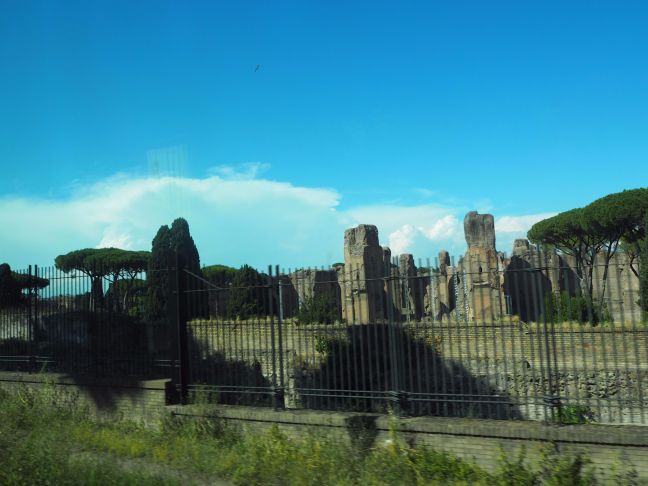
Our last stop for the day tour took us back into Rome to the Basilica of Saint Clement that was sits atop a necropolis. A necropolis by definition is a city that was once above ground, at city level, but over years was buried. Below the church are remnants of older churches and a pagan Mithra chapel. By the pagan chapel you could identify a street with apartments on each side. It is amazing to think that a city can be changed so much that roads and buildings could be covered and forgotten


After this last stop, part one of our tour ended and we headed back to our apartment for dinner. Clay cooked another delicious pasta dish. Before we met up for the second part of our tour, we grabbed our daily gelato. At this point, we were no longer enthused about gelato. It didn’t help that at this particular shop it was gross. I didn’t know there could be such a thing as bad gelato, but we had found it. After this evening, gelato eating became a chore.
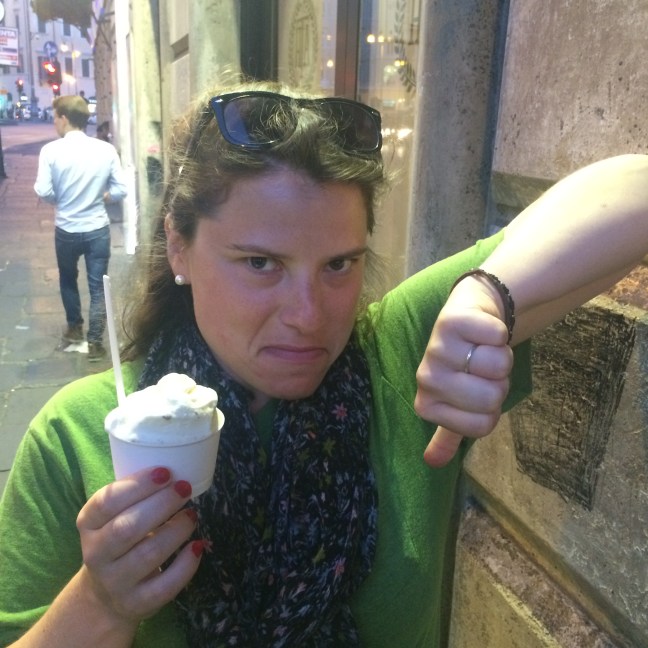
Sadly the gelato was only a sign of the tour to come. The second part of our tour had no ghosts and very little substance. It did provide a nice, quiet walk along the river and city as it changed from twilight to dark. It wasn’t perfect, but it was a nice way to end the day.


The next day was a big one. It was Vatican day. As a Catholic, this was at the top of my list of things to see. Clay was nice enough to oblige. To get a proper look at the place, we booked another Context tour. This tour was courtesy of Clay’s sister and her husband. When you are doing certain things in life, you don’t want to do them halfway. And the Context tour provides an excellent informational tour of the Vatican.


The Vatican hosts an amazing collection of all sorts of Italy, from paintings to tapestries, to sculptures and architecture, it has it all. They even have a modern art museum with a Dali in the collection.


The downside of course is the crowds. Worse than any football game I’ve ever been to. Almost the entire time you feel like being on a conveyor belt squashed between people. Seeing the Sistine Chapel, was akin to being crammed like sardines in a well painted tin can. It’s nice, but we both felt like the buildup was more than the actual place. There are a lot of incredible things to see in Italy, moreover Rome, that are not near as crowded. Even some of the rooms before getting the Sistine Chapel are really remarkable, but you don’t feel like you can enjoy it because of A. The crowds and B. You are rushing to get to the finish line aka: The Sistine Chapel.
We eventually exited to St. Peter’s. Tough to be crowded in a place so big. There are many remarkable things in the church, but we will only mention two here. First the canopy/baldachin. It is incredible large an ornate. Like most things in the Vatican it has a bit of a sinister side. All the bronze used to create the canopy was melted down from the pantheon.
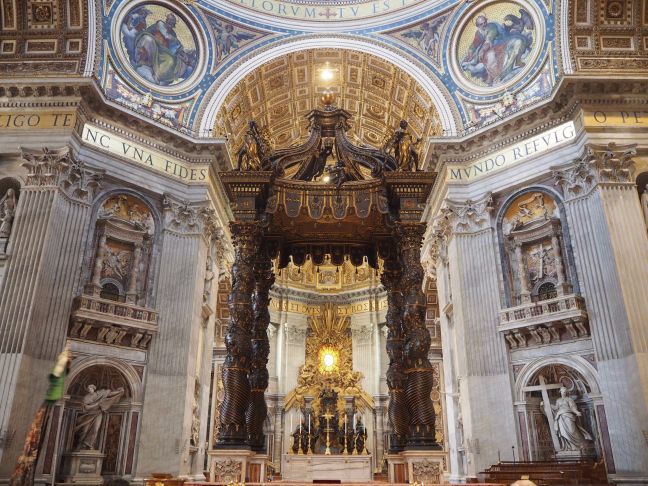


The second is the stained glass widow behind the canopy. It looks like stained glass, but it’s really marble of different thickness to let in more or less light. It is also surprisingly large. It was and I’m sure continues to be beautiful.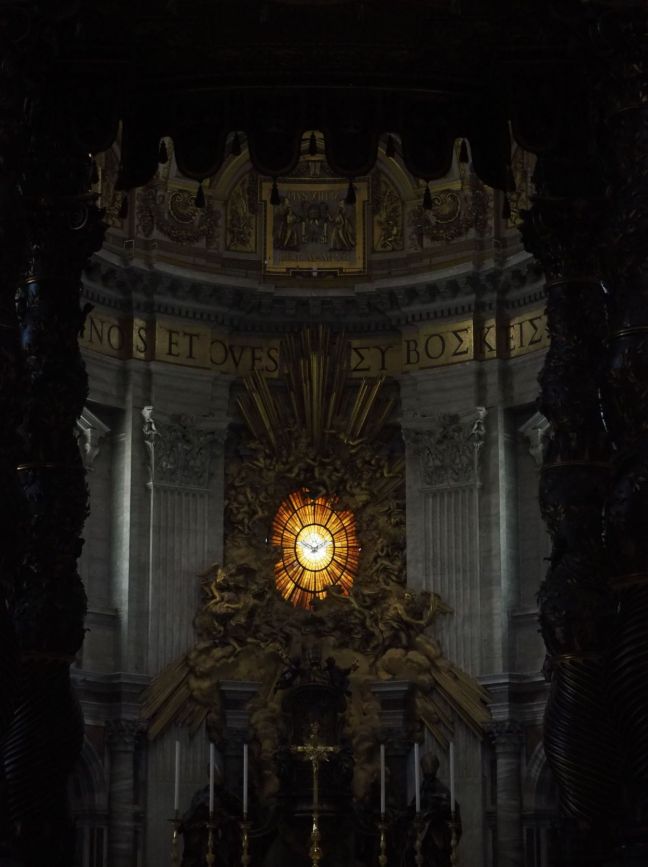
After a quick lunch break for pizza and gelato, we headed back to the Vatican. Not for more churching (as Clay likes to call it), but for what’s under the Vatican. I got us tickets to the Scavi tour. This is a Vatican run tour of the Necropolis and St. Peter’s tomb sitting beneath the Vatican. This not a typical tour that people go on. You have to be flexible when getting tickets. Instead of picking a tour time, you tell the Vatican when you will be in town and they tell you when you can go on the tour. We were excited and intrigued about what to expect, especially when the tour closes with us getting to see the bones of the first Pope of the Catholic church, St. Peter. The Peter of the apostles in the bible, Peter. The one with the keys and on this rock I will build my church… that Peter.
Before the tour starts, we are having to pass through the Swiss guards to get to our meeting point. I am already feeling excited. Then we get the whole no picture talk before the tour suddenly (in Clay’s words) takes a CIA/Da Vinci Code turn. We head to a glass door only opened with a special pass. Our small group crammed into a small hallway so that door can close completely before the next glass door is allowed to open with our guide’s special pass.


It was not easy to get down there. Most of the tour was interesting. We learned how the necropolis was not originally a Christian burial place, but eventually turned into one. After a fair amount of walking around, we go through a long process of explaining about Peter’s bones. Then the guide showed a hole in a wall that was illuminated. Inside the hole is a Plexiglass box filled with bones of a man who is believed to be Peter. They are sure the tomb is Peter’s, but they are less sure of the bones. The bones are of the time period and the bones are surrounded with lore, but no one can really say for sure.
Nevertheless, it was a fascinating tour and the Vatican does an excellent job of not sugar coating what they seem to know or not know.
 cornetravel